(i) The following information is included on the data sheet for an N-channel JFET : I_{DSS} = 20\text{ mA}, V_p = -8\text{V} and g_{mo} = 5000\text{ }\mu\text{s} Determine the value of drain current and trans-conductance at V_{GS} = -4\text{ V}.
What is the principle used in 'half-adder' ? Give the truth table for it.
Give the two forms of the De Morgan's theorem.
Draw a circuit diagram of an R-C phase shift oscillator. Explain its working. Derive an expression for its frequency.
Show that the condition of periodicity of lattice leads to the Bloch theorem. What is a Bloch function ?
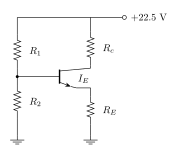
A transistor with \beta = 50, V_{BE} = 0.7\text{ V}, V_{CC} = 22.5\text{ V} and R_c = 5.6\text{ k}\Omega is used in biasing circuit as shown in the figure. It is designed to establish the quiescent potential at V_{CE} = 12\text{ V}, I_C = 1.5\text{ mA} and stability factor S \le 3. Find the values of resistors R_E, R_1 and R_2, where symbols have their usual meanings.
Derive the various current components in a p-n-p transistor when it is actively biased. Using Ebers-Moll model, show that for the common-emitter configuration I_C = -\alpha I_E - I_{CO} \left(E^{V_C/V_T} - 1\right) where the symbols have the usual meaning.
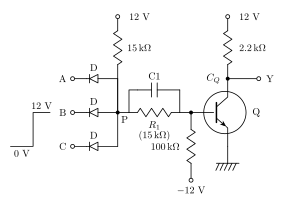
Explain the operation of the following circuit is a gate. Draw the truth table and find the operation carried out by this gate neglecting the source impedance.
junction saturation voltages and diode voltages in forward direction. Find the minimum value of h_{fe}.
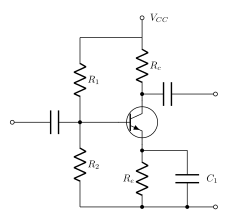
Calculate the gain of the following amplifier circuit :
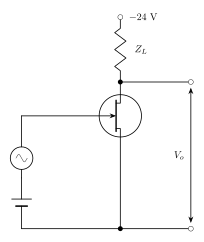
Given that g_m = 10\text{ mV/A}, r_d = 1\ \Omega and Z_L = 10\text{ k}\Omega.
In the following circuit, Show that the stability factor, S, is given by
S = \frac{1 + \beta}{1 + \frac{\beta R_e}{R_e + R_b}} Where R_b = \frac{R_1 R_2}{R_1 + R_2}
(i) What are high T_c superconductors ? Give two examples indicating their transition temperatures. Differentiate between the conventional and high T_c super conductors. (ii) Explain the principle of feedback in an amplifier. What are the advantages & negate feedback?
What is a Josephson junction ? Discuss dc and ac Josephson effects and obtain the relation. V = \frac{2eV}{h} where the symbols have their usual meaning.
Explain Meissner effect and Josephson effect. Describe their applications in the field of superconductivity.
What are the main applications of JFET? Discuss their advantages over bipolar transistors. Explain the working of n-channel JFET with the help of a schematic diagram.
(i) Show that a negative logic OR gate is like a positive logic AND gate. (ii) Distinguish between Hadrons and Leptons.
(i) Discuss the variation of free carrier concentration with temperature for an intrinsic and extrinsic semiconductors. (ii) Explain the effect of negative and positive voltage feedback on an amplifier characteristics.
Write down the characteristics of an ideal operational amplifier. Explain the term virtual ground. Draw a circuit diagram showing virtual ground in an operational amplifier.
Combinational switching circuit can perform an addition of the numbers held in two registers. (i) Write down the math table for the addition of two bits. (ii) Write down a Boolean expression for the necessary circuit functions. (iii) Arrive at the Exclusive-OR function. (iv) Draw the logic diagram for the circuit which performs the addition.
(i) Give a qualitative account of BCS theory of superconductivity. (ii) Obtain an expression for conductivity of an intrinsic semiconductor. How does it vary with temperature? (iii) The resistivity of an intrinsic semiconductor is 4.5\text{ ohm-m} at 20^\circ\text{C} and 2.0\text{ ohm-m} at 32^\circ\text{C}. Calculate the energy band gap.
(i) Obtain reciprocal lattice to normal BCC lattice. (ii) Describe Josephson junction and the effect. How is it exploited in the formation of a SQUID? Write down the applications of a SQUID. (iii) Distinguish between intrinsic and extrinsic semiconductors. Explain the concept of hole.