Consider that an ideal non-interacting Fermi gas with internal energy '\text{U}' at temperature \text{T} is kept in a cubical box of volume \text{V}. Find the pressure for the gas in terms of \text{U} and \text{V}.
8 Marks
Consider that an ideal non-interacting Fermi gas with internal energy '\text{U}' at temperature \text{T} is kept in a cubical box of volume \text{V}. Find the pressure for the gas in terms of \text{U} and \text{V}.
Explain why, at equilibrium, the chemical potential of a component must be the same in all coexisting phases. Derive the equilibrium condition for a binary liquid-vapour system in terms of chemical potential.
Consider a point charge of 5\text{ nC} placed at a distance of 1\text{ m} from a perfect conducting plane (z = 0) of infinite extent. Find the electric field at a point (2, 2, 0)\text{ m} and show that it is normal to the plane.
State and explain Kirchhoff's current law and Kirchhoff's voltage law. Derive these laws from the principles of charge conservation and energy conservation.
For a plane electromagnetic wave given by : \text{E}_{\text{z}} = \text{a}\cos \omega\text{x} \cos \omega\text{ct} \text{H}_{\text{y}} = -\text{a}\sin \omega\text{x} \sin \omega\text{ct} Find the value of the Poynting vector.
(i) Show that the vector potential \vec{\text{A}} at the position defined by the vector \vec{\text{r}} in a uniform electric and magnetic field is \vec{\text{A}} = \frac{1}{2}(\vec{\text{B}} \times \vec{\text{r}}).
(ii) Find out the divergence and curl of the vector potential \vec{\text{A}}.
Deduce Fresnel's law for the propagation of plane electromagnetic waves through an anisotropic dielectric medium.
\vec{E} = 10 \cos (\omega t - 100 x) \hat{j}\text{ V/m} In free space, an electric field (\vec{E}) is given by the following expression : \vec{E} = 10 \cos (\omega t - 100 x) \hat{j}\text{ V/m} Find the angular frequency \omega and the displacement current.
Consider a conducting sphere of radius ‘a’ in a uniform electric field \vec{E}. Find the induced surface charge density on the sphere and determine the electric field \vec{E} at a point P characterized by radius vector \vec{r}.
An electromagnetic wave has its magnetic field |\vec{B}| = 55 \times 10^{-8}\text{ T}. Determine the magnitude of the Poynting vector.
After highlighting the importance of the Biot-Savart law, show that the magnetic field of a current carrying long wire, at a point near it, is inversely proportional to the distance of the point from the wire.
A certain linear, homogeneous, isotropic, dielectric material has a relative permittivity, \varepsilon_{\text{r}} = 1\cdot 8. If potential \text{V} = -4000\text{y} volts in the material, then find :
(i) The electric flux density \text{D}, and
(ii) The polarisation \text{P}. Take vacuum permittivity \varepsilon_0 = 8\cdot 85 \times 10^{-12}\text{ farad/m}.
If volume charge density in free space varies as \rho_{\text{v}} = \frac{100\varepsilon_0}{\text{r}^{2/5}}, then using Poisson's equation, find potential \text{V}(\text{r}). It is assumed that \text{r}^2 \text{E}_{\text{r}} \rightarrow 0 when \text{r} \rightarrow 0, while \text{V} \rightarrow 0 at \text{r} \rightarrow \infty.
(i) What is the method of images ? What are the conditions which must be satisfied while applying the method of images to deal with electrostatic problems ?
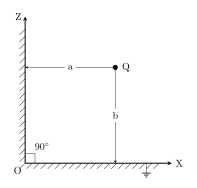
(ii) A point charge \text{Q} is located at the point (\text{a}, 0, \text{b}) between two semi-infinite conducting planes intersecting at right angles as shown in the figure. Using the method of images, determine the potential at point \text{P}(\text{x}, \text{y}, \text{z}) in the region \text{z} \ge 0 and \text{x} \ge 0 and the force on \text{Q}.
Show that the electromagnetic wave equation is invariant under Lorentz transformations.
Derive the Planck's radiation law for blackbody radiation using the Bose-Einstein distribution function. Explain how results from quantum statistics differ from classical results derived from the Rayleigh-Jeans law.
A parallel plate capacitor having circular plates of radius 10\text{ cm} is being charged. If the electric field at any instant within the capacitor changes at the rate 5\cdot 0\text{ V m}^{-1}\text{ s}^{-1}, calculate the magnetic intensity |\vec{H}| inside the capacitor.
Consider a long straight wire of length L carrying a current I. Determine the magnetic vector potential \vec{A} at a point P located at distance x from the wire.
As shown in the figure, a series circuit connected across a 200\text{ V}, 60\text{ Hz} line consists of a capacitor of capacitive reactance of 30\ \Omega, a non-inductive resistor of 44\ \Omega and a coil of inductive reactance 90\ \Omega and resistance 36\ \Omega.
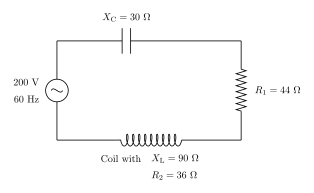
Determine : (i) Power factor of the circuit (ii) Power absorbed by the circuit (iii) Power dissipated in the coil
A rectangular coil consists of 50 closely wrapped turns and has dimensions of 0\cdot 5\text{ m} \times 0\cdot 4\text{ m}. It carries a current of 1\cdot 5\text{ A}. If a uniform magnetic field B = 0\cdot 1\text{ T} is applied such that the direction of the magnetic field makes an angle of 60^\circ with respect to the plane of the coil, what is the torque exerted on the coil by the magnetic field?