Write a short note on Para and ferromagnetism.
20 Marks
Write a short note on Para and ferromagnetism.
What is the role of transistor in an amplifier?
Explain the formation of potential barrier in an unbiased p-n junction.
If a signal from a high impedance source is to be amplified, which configuration is preferred and why?
What will happen to output voltage of an amplifier if a part of the output is returned to the input (i) in phase (ii) 180^\circ out of phase ?
Write a short note on zener diode.
Why do the electronic energy level in a solid form bands? Describe in terms of the band theory the difference between a conductor, an intrinsic semi-conductor and an insulator. How does the energy level change when some impurities are introduced in a semiconductor? Explain how by doping you have both n-type and p-type semiconductors starting with pure Germanium. The band gap in cases of Germanium is about 0.8\text{ eV} at Ok. Neglecting the variation of band gap with temperature, make a rough estimate of the temperature at which the resistance of a pure Germanium sample will be reduced to 1/e times its value at 300k.
How is a p-n junction prepared? Explain the charge and potential distributions in such a junction in open circuit. Explain how a p-n junction can be used to build a solar cell. Describe the mechanism of the increase of conductivity of Germanium by doping it with Arsenic.
What is superconductivity? In what kind of materials is it found to occur? Name some parameters which characterise a superconductor. Cite any two major use if we succeed in making superconductors with T_c not far atmospheric temperatures.
Write a brief scientific note on Logic gates and their applications.
Write a brief scientific note on Transistor as an amplifier.
Considering the electrons in the atom, what is the difference between a diamagnetic and a paramagnetic substance? State how magnetic the susceptibility varies with temperature for dia, para, ferro- and anti-ferro-magnetic materials. (No theoretical discussion required.)
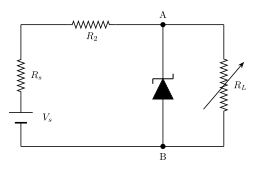
What is a Zener diode? Explain what function it performs in the circuit given below as the load resistance R_L is varied. What is the purpose of introducing resistor R_2 in the circuit? (V_s and R_s represent source voltage and resistance, respectively).
State the difference in the electronic energy states in an isolated atom and in a solid. Hence explain difference between a conductor, an insulator and an intrinsic semiconductor. What is the role of impurities in so-called extrinsic semiconductors?
What is a P.N. junction? Describe with energy level diagram the formation of double layer of charges which generates a potential difference (V) across, the junction. Hence show that the capacitance of the double layer. C=KV^{-1/2}, where K is a constant. State some practical use of this relation between C and V.
Write a shout note (about 200 words) on super-conductors and the nature of revolution that may come up if superconductors with critical temperature well above the room temperatures are developed.
Define Fermi energy. Show that the Fermi level lays half-way between the top of the valence band and the bottom of the conduction band of an intrinsic semiconductor. Explain why an extrinsic semiconductor, such as an N-type crystal, has more free electrons than holes but is found to be electrically uncharged.
Draw the circuit diagrams suitable for measuring the voltage amplification of a triode valve with the following methods of connection: (a) Common cathode (b) Common grid (c) Common anode. Write down, without proofs, the expression for amplification in each case in terms of \mu and the relevant resistance values. Which of the three methods is usually employed in high frequency circuit practices and why ?
Give an account of the basic principles of radio transmission and reception. Detailed circuits are not necessary but schematic diagrams indicating functions of various units may be shown.
Draw a complete circuit for common emitter (small signal) amplifier for low frequencies and explain briefly its working.